
Our materials and environmental impact
Worn for a day. Binned by dinner.
That’s the life of most plastic name badges. Ours are made to be planted, recycled or composted, depending on the paper.
See how we work it out
Why we exist
of plastic badge sets a year, if every guest at Australia’s business events wore one.1
of plastics like these were recovered in Australia in 2020–21.2
Based on 43.7 million business event attendances in 2018–19. An upper limit: not every event uses badges, and some guests attend more than one.
We thought there had to be a kinder way.
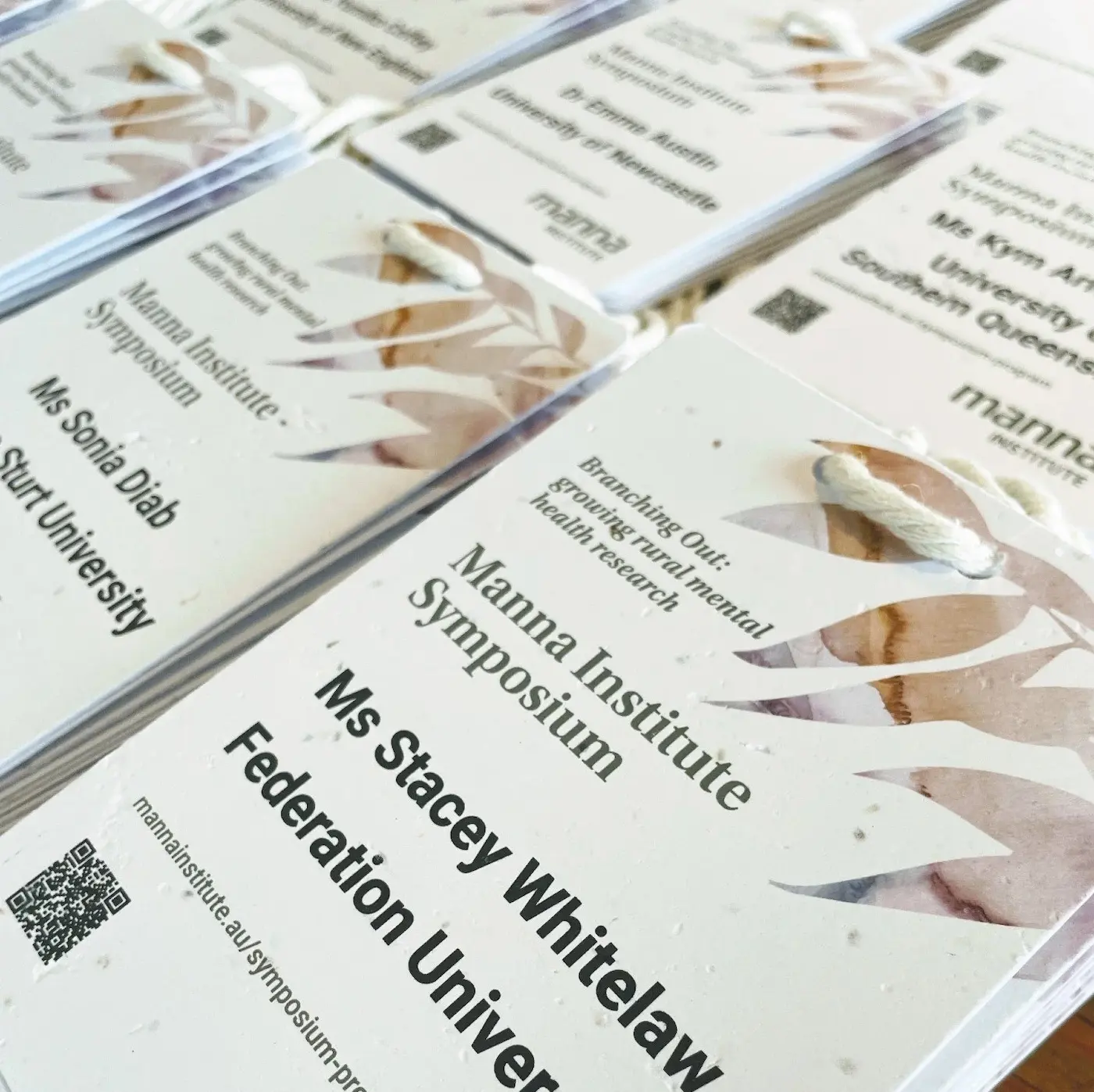
So in 2023, we started making badges by hand from paper other people throw away. Offcuts from printers and offices, torn by hand, pulped in an old café blender, pulled on a fly-screen mould and dried in the Queensland sun.
No plastic. Just paper and a cotton cord.

For every 100 guests
less plastic.
less CO₂e.
Your quote shows both figures for your own order, ready for your sustainability report.
Compared with plastic holders, printed inserts and synthetic lanyards. A7 badges save 3.1 kg of plastic. CO₂e counts making the materials only.
Paper and cotton. That's it.
Scroll sideways to see the whole table.
| Terra Tag badge | Typical plastic badge set | |
|---|---|---|
| Badge | Handmade seed paper or 100% recycled paper, printed with water-based ink | A printed paper insert inside a plastic holder |
| Lanyard | Undyed, biodegradable cotton cord, already attached | Synthetic lanyard with a plastic clip |
| Plastic | None | 33 g (A6) or 31 g (A7) |
How we work it out
Two figures. Two simple sums.
Plastic
Your badges × 33 g (A6) or 31 g (A7)We weighed the plastic in a typical badge set: the holder, the lanyard and the clip.
100 A6 badges = 3.3 kg less plastic.
CO₂e
Your badges × 0.11 kgThat’s the difference between making a plastic badge set and making ours. CO₂e puts every greenhouse gas into one number.
100 badges = 11 kg less CO₂e.
Both sums count every badge in your order, named and blank.
Our workings
We weighed each part, then multiplied by a published figure for the emissions from making that material.3
Scroll sideways to see the whole table.
| Badge set (A6) | Weight of each part | CO₂e to make it |
|---|---|---|
| Plastic badge set | Plastic holder (PVC) 14 g, printed paper insert 3 g, synthetic lanyard and clip (PET) 19 g | 0.12 kg |
| Terra Tag badge | Recycled paper badge 7 g, undyed cotton cord 0.5 g | 0.01 kg |
| Saved per badge | 0.12 − 0.01 | 0.11 kg |
We use the same 0.11 kg for every size and paper, so every quote is worked out the same way. The insert is paper, so it isn’t counted as plastic.
The figures cover making the materials only, not our papermaking, printing, delivery or what happens after your event. They’re an estimate, not a full life-cycle measurement, and not a carbon offset.
How to dispose of name tags and lanyards
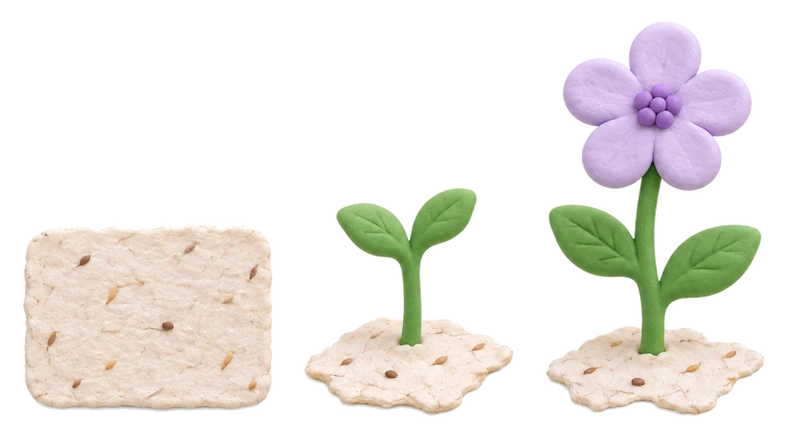
- Seed paper: plant it, or tear it up and compost it.4 Not the recycling bin.
- Recycled paper: take the cord off, then recycle it, or tear it up and compost it.4
- Cotton cords: compost them5 (worms love them), or reuse them as garden twine.
Keep badges and cords out of your council’s food and garden (FOGO) bin.6 The QR code on the back of most badges takes guests to our planting and recycling instructions.
Not all eco-friendly name badges are equal
Laminated, bamboo, recycled plastic and bioplastic badges are often sold as green. Here’s where they can actually go.
Scroll sideways to see the whole table.
| Material | Recycling bin | Compost | Food and garden bin |
|---|---|---|---|
| Terra Tag paper | Recycled paper: yes, with the cord off4 | Yes, torn up, in a home compost. Seed paper can be planted4 | No6 |
| Laminated paper | No. Its plastic coating stops it being recycled7 | No guidance found | Not on the lists we checked |
| Bamboo or wood | Not on the lists we checked | No guidance found | Victoria’s draft rules exclude bamboo and wood items such as cutlery8 |
| rPET (recycled plastic) | Check with your council. Lists cover bottles and containers9 | No. Polyester fibres didn’t break down in compost5 | No6 |
| PLA (plant-based plastic) | Check with your council. Victoria’s draft rules exclude bioplastics8 | Only where certified (AS 4736 commercial, AS 5810 home)1011 | Check with your council. NSW and WA keep them out6 |
| Tyvek (“pocketless” badges) | Only at a specialist facility for flexible HDPE plastic,12 which few areas have | No12 | No6 |
Rules vary by council, so check yours.
Sustainable event examples
Every figure is worked out with the method above.13
Scroll sideways to see the whole table.
| Event | Badges | CO₂e saved |
|---|---|---|
| International Congress for Conservation Biology 2025, Brisbane | 1,986 A7 seed paper | 218.46 kg |
| ARMS (Australasian Research Management Society) conference 2025, Adelaide | 850 A7 seed paper | 93.5 kg |
| MAVLab, Municipal Association of Victoria, Melbourne | 400 A7 seed paper | 44 kg |
| IAG, Sydney | 320 A7 seed paper | 35.2 kg |
| ACCC National Consumer Congress | Seed paper | 25.3 kg |
| Zoo and Aquarium Association conference, Darwin | 161 A6 recycled paper | 17.71 kg |
| NSW Treasury Corporation, A50 Australian Economic Forum, Sydney | 140 A6 recycled paper | 15.4 kg |
Planning the rest of your event? Start with our green event checklist.
Questions
Can we use these figures in our sustainability report?
Yes, as a supplier’s estimate. For example: "Terra Tag estimates our 250 A6 badges saved 8.2 kg of plastic and 27.5 kg CO₂e in material production, compared with plastic holders, printed inserts and synthetic lanyards." Use the figures on your quote and link this page as the method.
Are your badges zero waste?
We don’t call them that. There’s no plastic in them, and every part has somewhere to go after your event. But making, printing and delivering them still leaves a footprint.
Which badge has the lowest impact?
Both papers save the same CO₂e, so choose by what happens next. Seed paper name badges if guests will plant them. Recycled paper name badges if they’ll recycle them. Seed paper can’t be sent to WA or Tasmania, so choose recycled there.
Choose badges that leave less behind
Price seed paper name badges or recycled paper name badges, and your quote will show what your order saves. Still deciding? Compare all three options.
Sources
- Business event attendances: EY for the Business Events Council of Australia, Value of Business Events to Australia: FY19 High Level Update, March 2020: 43.7 million attendances in 2018–19, an estimate, not a count. Upper limit: 43.7 million × 33 g of plastic per A6 set.
- Plastics recovery: Australian Government, Australian Plastic Flows and Fates Study 2020–21. The rate for non-packaging plastics, counting recycling and energy recovery, not a measured rate for badges.
- Emission factors for making each material: UK Government greenhouse gas conversion factors 2026, primary material production: PVC 2.94, PET 3.86 and virgin paper 1.34 kg CO₂e per kg; recycled paper 1.05. Cotton cord 5.8, combining Australian cotton lint (CRDC project DAN1508, 2016) and yarn spinning (Cotton Incorporated life cycle assessment, 2017), the closest published figures for a cord. Weights: Terra Tag, kitchen scale, 26 October 2026, for A6. A7: holder 12 g (estimated, slightly smaller than A6), insert 1.5 g and paper badge 3.5 g (half the A6 weights), the same lanyard, clip and cord. CO₂e is worked out from the A6 weights, rounded to two decimals, and used for both sizes.
- Paper: Planet Ark, Recycling Near You: office paper (string is screened out at the recycler, so take the cord off); ACT Government, Recyclopaedia: paper (scraps and shredded paper can be composted). These cover paper, not our printed badge specifically.
- Cotton and polyester in compost: Kaya and colleagues, 2023; Alwala and colleagues, 2024. Studies of cotton yarn and fabric, not our cord or an rPET badge.
- Council food and garden bins: NSW EPA, FOGO bin; WA Waste Authority, towards cleaner compost. Rules vary by council.
- Laminated paper: ACT Government, Recyclopaedia: laminated paper: “covered in a plastic coating and cannot be recycled”.
- Victorian Government, Household Waste and Recycling Draft Service Standard 2024, Tables 3 and 5. A consultation draft; badges aren’t named, so the nearest listed items are used.
- Planet Ark, Recycling Near You: plastic containers and packaging.
- PLA in soil and compost: Clements and colleagues, Journal of Xenobiotics, 2026.
- Compostable certification: Australasian Bioplastics Association.
- Tyvek: DuPont, What is Tyvek?; DuPont, Tyvek design FAQ, Q20.
- Terra Tag’s order records, and our published ACCC case study: each figure is badges × 0.11 kg CO₂e.